
Blog
Box-and-Pan Brake vs. Press Brake: Choose by the Parts You Make

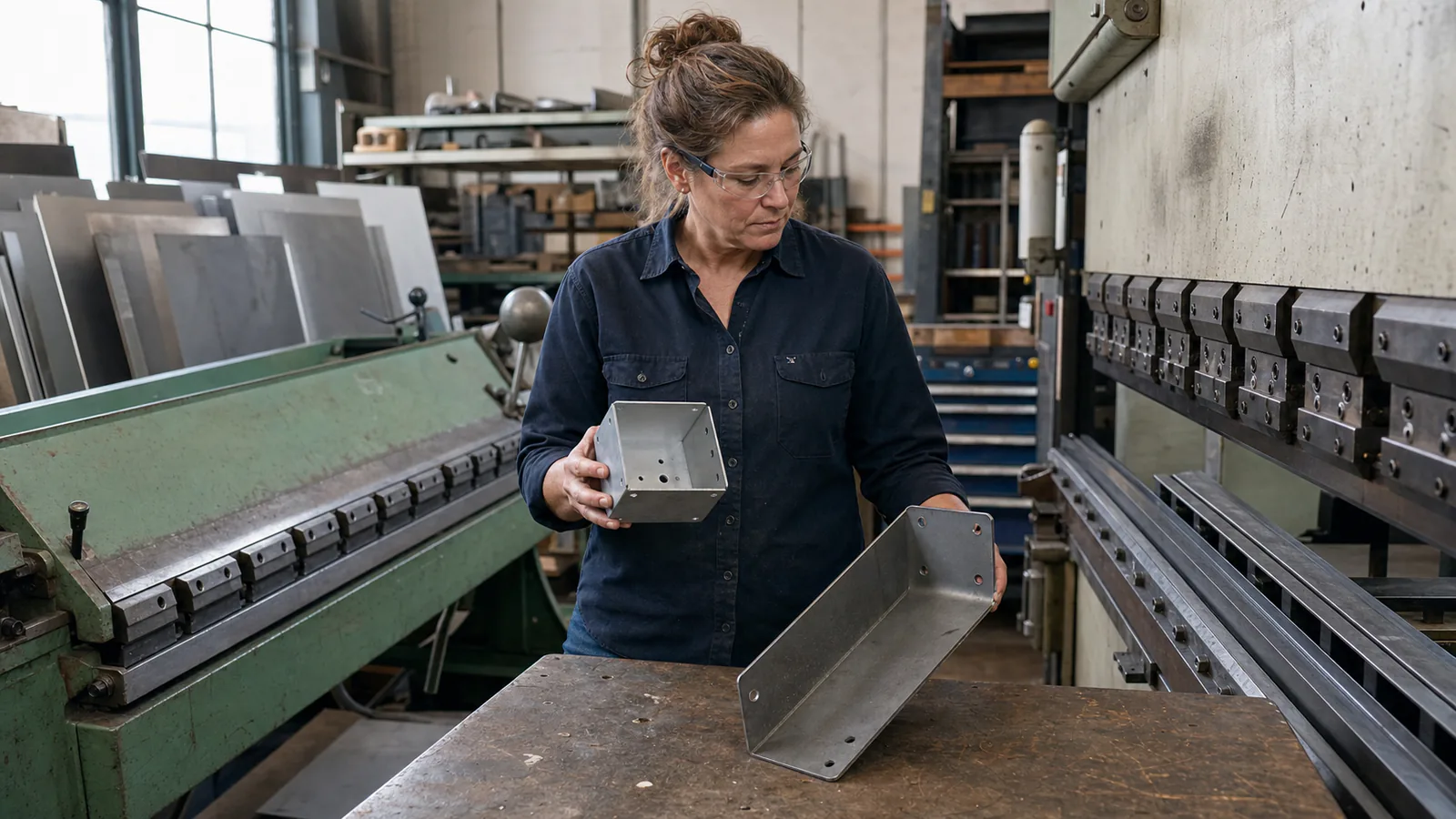
Compare box-and-pan brakes and press brakes by material, bend length, box depth, tooling, repeatability, production volume and installed cost.
Both machines bend sheet metal, but they do not solve the same problem in the same way.
A box-and-pan brake uses a clamping beam with removable fingers so adjacent flanges can clear during box and tray work. A press brake drives a punch into a die, offering broad tooling choices and a wider range of forming capabilities.
If you compare them only by maximum thickness and bend length, you can miss the feature that actually controls the job: part geometry.
Bring the parts to the decision.
What a box-and-pan brake does well
A box-and-pan brake—often called a finger brake—is designed for straight bends in sheet material. Removable or adjustable fingers create clearance for previously formed side flanges.
It is often a practical fit for:
- Boxes, pans and trays
- Cabinets and enclosures
- HVAC and general sheet-metal work
- Prototype and maintenance fabrication
- Short-run work
- Parts with adjacent flanges
Manual versions offer simple operation and lower utility requirements. Powered models can reduce operator effort and improve production capability. The exact material capacity changes with model, bend length and material.
What a press brake does well
A press brake forms material between matched or compatible punches and dies. Tooling choices allow the machine to produce many flange, channel, offset, radius and special forms.
It is often a strong fit for:
- Broader thickness ranges
- Longer or heavier bends
- Repeat production
- Parts requiring multiple tooling profiles
- Controlled bend sequences
- Work benefiting from backgauge positioning or CNC programming
A press brake also brings more decisions: tonnage, tooling load, die opening, daylight, stroke, backgauge axes, crowning, controls and safeguarding.
Direct comparison
| Decision factor | Box-and-pan brake | Press brake |
|---|---|---|
| Basic sheet-metal boxes and trays | Strong fit | Capable with suitable tooling and sequence |
| Adjacent flange clearance | Removable fingers are the defining advantage | Requires suitable sectional tooling and clearance planning |
| Heavy or broad forming range | Model-dependent and generally more limited | Broad range when machine and tooling are correctly specified |
| Tooling variety | Focused around clamping fingers and bending leaf | Extensive punch-and-die options |
| Repeatability and programming | Manual or powered stops depending on model | Backgauge and CNC options available |
| Setup complexity | Often straightforward | Can be higher; depends on tooling and controls |
| Initial investment | Often lower for comparable light-gauge work | Usually higher, especially with tooling and CNC |
| Utility and installation needs | Manual models can be simple | Powered systems require a more developed installation plan |
| Best decision input | Box depth, flange geometry and sheet range | Bend force, geometry, tooling and production mix |
Let box depth and flange sequence lead
For a box or tray, identify:
- Inside dimensions
- Material and thickness
- Flange height
- Bend radius
- Order of bends
- Clearance needed for completed flanges
On a box-and-pan brake, finger selection and the shape of the clamping beam affect clearance. A machine may have enough nominal bending length but still be unable to complete a deep box because the part interferes with the beam or apron.
On a press brake, segmented tooling, punch shape, die height, daylight, stroke and throat all influence the sequence. A drawing or bend simulation is the fastest way to expose interference.
Compare production, not only capability
If a part can be made on both machines, compare the complete cycle.
Time:
- Tool or finger setup
- Material positioning
- Each bend
- Part turning and support
- Angle checking
- Adjustments
- Unloading and stacking
A manual finger brake may be highly efficient for a short run of simple enclosures. A programmable press brake may create more value when the same parts repeat, dimensions change frequently or the shop needs controlled positioning across a family of parts.
Think about bend accuracy in context
Accuracy depends on more than the machine category.
Material thickness, grain direction, springback, tooling condition, operator technique, setup and gauging affect the result. A press brake with capable controls can improve repeatability, but it does not eliminate material variation. A box-and-pan brake can produce dependable work when it is correctly adjusted and used within capacity.
Define what the finished part requires:
- Angle tolerance
- Flange-length tolerance
- Inside dimensions
- Surface condition
- Fit with mating parts
- Inspection method
Do not pay for precision that the product does not require. Do not accept a process that forces repeated manual correction on every part.
Review material capacity correctly
Confirm actual thickness and grade. Do not treat all gauge references as equivalent.
For a box-and-pan brake, capacity may change with bending length or material strength. For a press brake, required tonnage depends on bend length, thickness, strength, die opening and forming method.
Ask for written confirmation using the most demanding recurring part. If stainless, high-strength material or a tight radius is involved, state that clearly.
Include tooling and accessories in the price
For a box-and-pan brake, review:
- Finger widths and segmentation
- Nose radius
- Clamping adjustment
- Backgauge or stop system
- Crown adjustment where applicable
- Part supports
- Powered options
For a press brake, review:
- Punch and die profiles
- Tool lengths and segmentation
- Clamping system
- Rated tooling load
- Backgauge configuration
- Crowning or compensation
- Tool storage and handling
The useful price is the cost of a production-ready setup, not a bare machine.
Consider the next three years of work
Do not base the decision only on one current project. Review the parts you expect the shop to pursue.
A box-and-pan brake may remain the right investment when the business is centered on light-gauge boxes, pans and enclosures. A press brake may provide a better growth path when work is becoming heavier, more varied or more repeatable.
Some shops need both. The finger brake handles quick sheet-metal work without interrupting a press brake scheduled for production parts.
Plan safety and material handling
Both machines create pinch and point-of-operation hazards. Review guarding, controls, emergency stops, foot controls, part support and operator position for the actual bend sequence.
OSHA requires appropriate safeguarding where machine operation exposes employees to injury. Employers are also responsible for training and controlling hazardous energy during covered service work.
Large sheets can be a handling hazard even when the material is light. Plan support so operators are not forced to balance a sheet while reaching for a control.
Which machine should you choose?
Start with a box-and-pan brake when:
- Boxes, trays and enclosures dominate the workload.
- Material is within the brake’s confirmed capacity.
- Short runs and flexible manual setup are common.
- Adjacent-flange clearance is the central challenge.
- A simpler installation fits the operation.
Start with a press brake when:
- Work spans a wider range of materials and geometries.
- Repeatability and programmable positioning matter.
- Longer, heavier or more complex bends are common.
- The shop needs a broad tooling system.
- Production demand justifies the investment and setup.
Frequently asked questions
Can a press brake make boxes and pans?
Yes, with suitable segmented tooling, clearance and a workable bend sequence. Verify the complete geometry before selecting the machine and tools.
Is a finger brake more accurate than a press brake?
Neither category is universally more accurate. The machine, tooling, material, setup, operator and measurement method determine the result.
Can a box-and-pan brake bend stainless steel?
Some models can bend suitable stainless thicknesses, usually at a lower capacity than mild steel. Confirm the exact material and bend length with the manufacturer.
Do I need both machines?
Possibly. Separate machines can prevent quick sheet-metal jobs from interrupting scheduled press-brake work. The answer depends on volume, part mix and available floor space.
Send the difficult box or bend
Give GT Machinery Solutions the drawing, material, thickness, flange dimensions, bend sequence and volume. We will help you identify whether a finger brake, press brake or another forming process deserves the first look.
CTA: Discuss Your Sheet Metal Forming Application
Related reading
- Press Brake Buying Guide
- How to Choose Industrial Metalworking Machinery
- The True Cost of Industrial Machinery
- Contact Us
Sources
Important: Verify capacities, guarding, installation requirements and safe operating procedures with the machine manufacturer, current manuals and qualified personnel before purchase or use.