
Blog
The True Cost of Industrial Machinery: Calculate More Than the Purchase Price

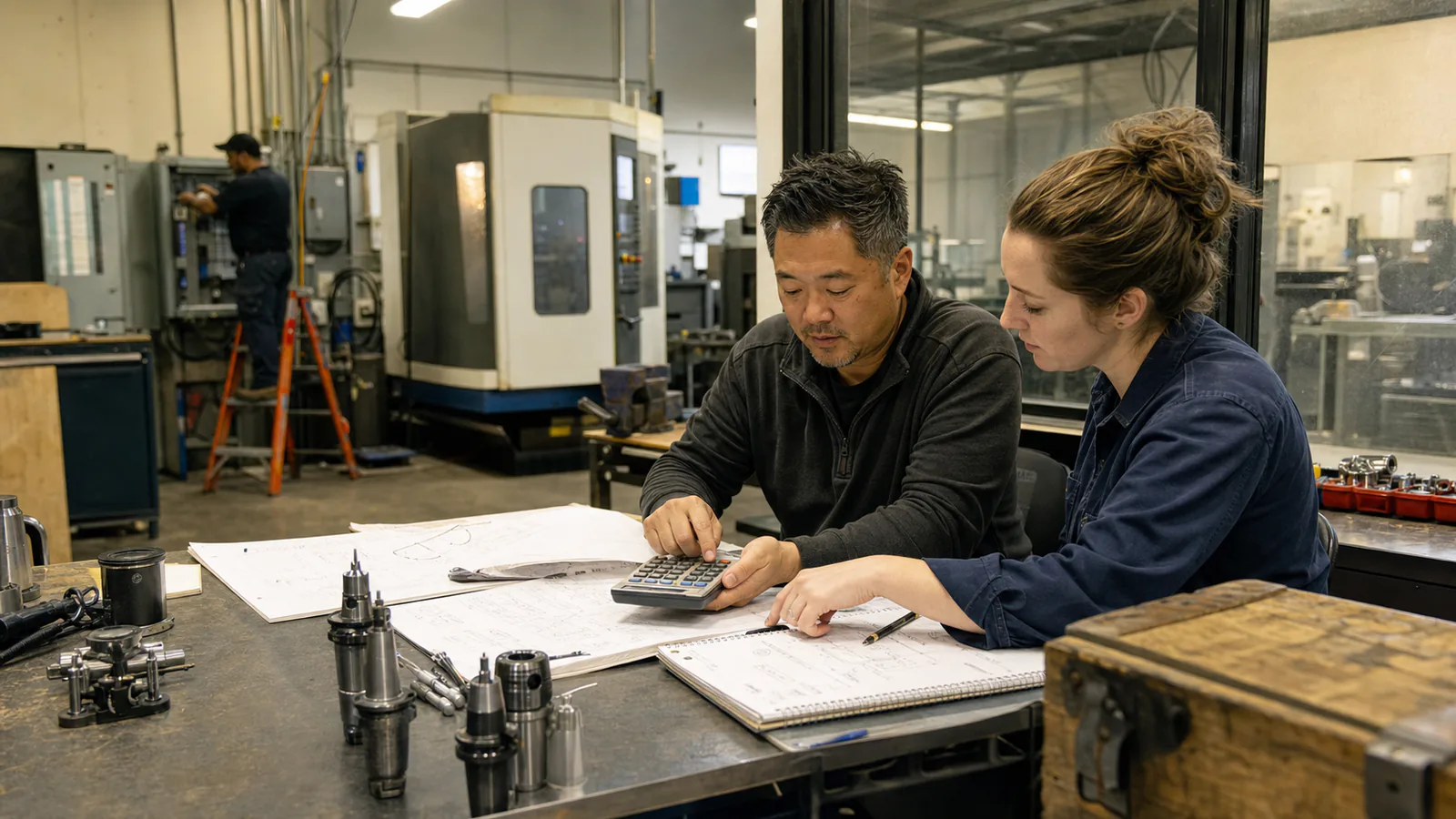
Calculate industrial machinery cost using freight, rigging, utilities, tooling, training, labor, maintenance, downtime and production value.
The machine price is easy to compare because it arrives as one number.
The real cost is spread across the purchasing process: freight, rigging, electrical work, tooling, training, maintenance, labor, scrap and downtime. The real return is spread across production: shorter cycles, reduced setup, less rework, more capacity and work that no longer has to be outsourced.
If you compare only purchase prices, you can select the lower quote and still approve the more expensive decision.
Build a total-cost view instead.
Start with installed cost
Installed cost is the amount required to get the machine safely producing an acceptable part.
Include:
| Cost category | What to include |
|---|---|
| Equipment | Base machine, options, controls and accessories |
| Commercial | Taxes, payment or financing costs where applicable |
| Transportation | Freight, insurance and special delivery services |
| Receiving | Forklift, crane, rigger, storage or re-delivery |
| Facility | Foundation, floor work, anchors and layout changes |
| Utilities | Electrical, transformer, air, extraction, water or network |
| Tooling | Initial production tooling, workholding and gauges |
| Supplies | Coolant, lubricant, blades, abrasives and test material |
| Commissioning | Setup, leveling, startup and verification |
| Training | Operator and maintenance time, travel or service fees |
Ask each internal department to own its line. Purchasing may know freight; facilities may know power; production may know tooling; finance may know tax and capital cost. One person rarely has every number.
Estimate annual operating cost
Once installed, the machine consumes more than power.
Annual ownership costs can include:
- Direct operator labor
- Setup labor
- Programming
- Tooling wear
- Blades, abrasives and consumables
- Coolant, lubricants and filters
- Electricity and compressed air
- Inspection
- Preventive maintenance
- Repair labor and parts
- Software or connectivity fees
- Waste disposal
- Floor-space opportunity cost
Do not assume the more automated machine has no labor cost. Operators still load, unload, inspect, manage material, change tools and respond to interruptions. Automation may shift labor toward higher-value work rather than eliminate it.
Put downtime into dollars
Downtime is often discussed emotionally and calculated poorly.
Separate:
- Planned maintenance
- Setup and changeover
- Material shortages
- Tooling delays
- Operator availability
- Quality holds
- Machine failures
- Waiting for service or parts
Then estimate the business impact. Lost machine hours do not always equal lost sales, particularly when another operation is the real constraint. Focus on the cost to the system: delayed shipments, overtime, subcontracting, idle downstream labor or missed capacity.
Ask prospective suppliers about manuals, diagnostics, parts identification, routine maintenance and technical-support channels. Do not convert a sales promise into a financial assumption unless it is documented.
Measure the current process first
An ROI model is only as good as its baseline.
Observe representative jobs and record:
- Setup time
- Cycle time
- Loading and unloading
- Inspection
- Scrap and rework
- Secondary finishing
- Queue time
- Downtime
- Outside-processing cost
Use several jobs, not the best demonstration part. High-mix shops need a weighted model that reflects the actual product mix.
NIST emphasizes that productivity improvement requires planning and can involve cost reduction, technology adoption, lean methods and working smarter. NIST also describes simulation as a way to identify bottlenecks and test expected changes in throughput, labor and layout before implementing capital projects.
Calculate annual benefit
Potential benefits include:
- Labor hours avoided or reassigned
- Reduced setup time
- Reduced scrap and rework
- Reduced outsourced processing
- Reduced secondary finishing
- Increased sellable capacity
- Shorter lead time
- Lower overtime
- Better material yield
- Improved quality consistency
Be conservative. Saved minutes have financial value only if they reduce cost, prevent additional spending or create usable capacity.
For example, a machine may save four operator hours each week. If those hours simply become unplanned idle time, the cash benefit is limited. If the same team uses them to complete additional profitable work, avoid overtime or replace subcontracting, the benefit is stronger.
Use a simple payback model
A basic planning calculation is:
Simple payback period = Total installed investment ÷ Expected annual net benefit
Annual net benefit should subtract the new machine’s added annual operating cost from the measurable annual gains.
Example structure:
| Annual effect | Amount |
|---|---|
| Labor or overtime benefit | $ |
| Outsourcing avoided | $ |
| Scrap and rework reduction | $ |
| Additional contribution from usable capacity | $ |
| Less added operating and maintenance cost | ($) |
| Expected annual net benefit | $ |
Simple payback does not account for every financial factor. Finance may also evaluate depreciation, taxes, interest, cash flow, net present value and risk.
Compare scenarios, not one forecast
Create conservative, expected and strong cases.
Conservative
- Lower production demand
- Smaller labor improvement
- Higher setup time
- Higher maintenance allowance
- No unconfirmed new sales
Expected
- Current approved forecast
- Observed process improvement
- Normal maintenance and uptime assumptions
Strong
- Higher demand
- Successful workflow changes
- Added work that sales has reasonable evidence to support
If the purchase works only in the strongest scenario, the risk deserves attention.
Include the cost of doing nothing
Keeping the current process is also a decision.
Calculate:
- Current annual repair cost
- Overtime caused by the constraint
- Outsourcing cost
- Scrap and rework
- Lost capacity
- Delay risk
- Safety or ergonomic concerns requiring correction
- Opportunity cost of unavailable capabilities
Do not exaggerate hypothetical lost sales. Use documented late work, declined quotes, subcontracting invoices and actual queue data.
Watch for hidden comparison errors
Comparing a complete quote with a bare machine
Normalize tooling, freight, startup and options before comparing totals.
Counting all saved labor as cash
State how those hours will be used or removed from cost.
Assuming full utilization immediately
Allow for training, ramp-up and process development.
Ignoring the bottleneck
More capacity at a non-constraint may only create a larger queue downstream.
Excluding maintenance
Every machine needs planned service and consumables.
Treating every future sale as guaranteed
Separate approved demand from opportunity.
A one-page machinery business case
Your approval summary should answer:
- What operating problem are we solving?
- What data proves the problem?
- Why is equipment the right response?
- What is the total installed investment?
- What annual cost will the machine add?
- What measurable benefit will it create?
- What is the conservative payback?
- What risks could prevent the result?
- Who owns installation and implementation?
- How will results be measured after launch?
Frequently asked questions
What costs are most often forgotten?
Rigging, electrical work, tooling, initial consumables, training, material support and production ramp-up are common omissions.
Should freight be included in equipment ROI?
Yes. Freight and receiving are part of the installed investment required to put the asset into service.
How should labor savings be valued?
Use the financial effect the business can actually realize: avoided overtime, avoided hiring, reassigned productive work or added contribution from usable capacity.
Is the least expensive machine usually the best ROI?
No. ROI depends on installed cost, operating cost, capability, reliability, workflow and measurable benefit—not initial price alone.
Compare production-ready proposals
Ask GT Machinery Solutions to help you identify freight, tooling, utility and delivery inputs that belong in the comparison. Final financial approval remains yours, but the equipment quote should support a complete business case.
CTA: Request Application and Purchasing Guidance
Related reading
- How to Choose Industrial Metalworking Machinery
- How to Find a Fabrication Shop Bottleneck
- Industrial Machine Installation Checklist
- Shipping Policy
- Contact Us
Sources
Important: Verify capacities, guarding, installation requirements and safe operating procedures with the machine manufacturer, current manuals and qualified personnel before purchase or use.