
Blog
How to Find a Fabrication Shop Bottleneck Before You Buy Another Machine

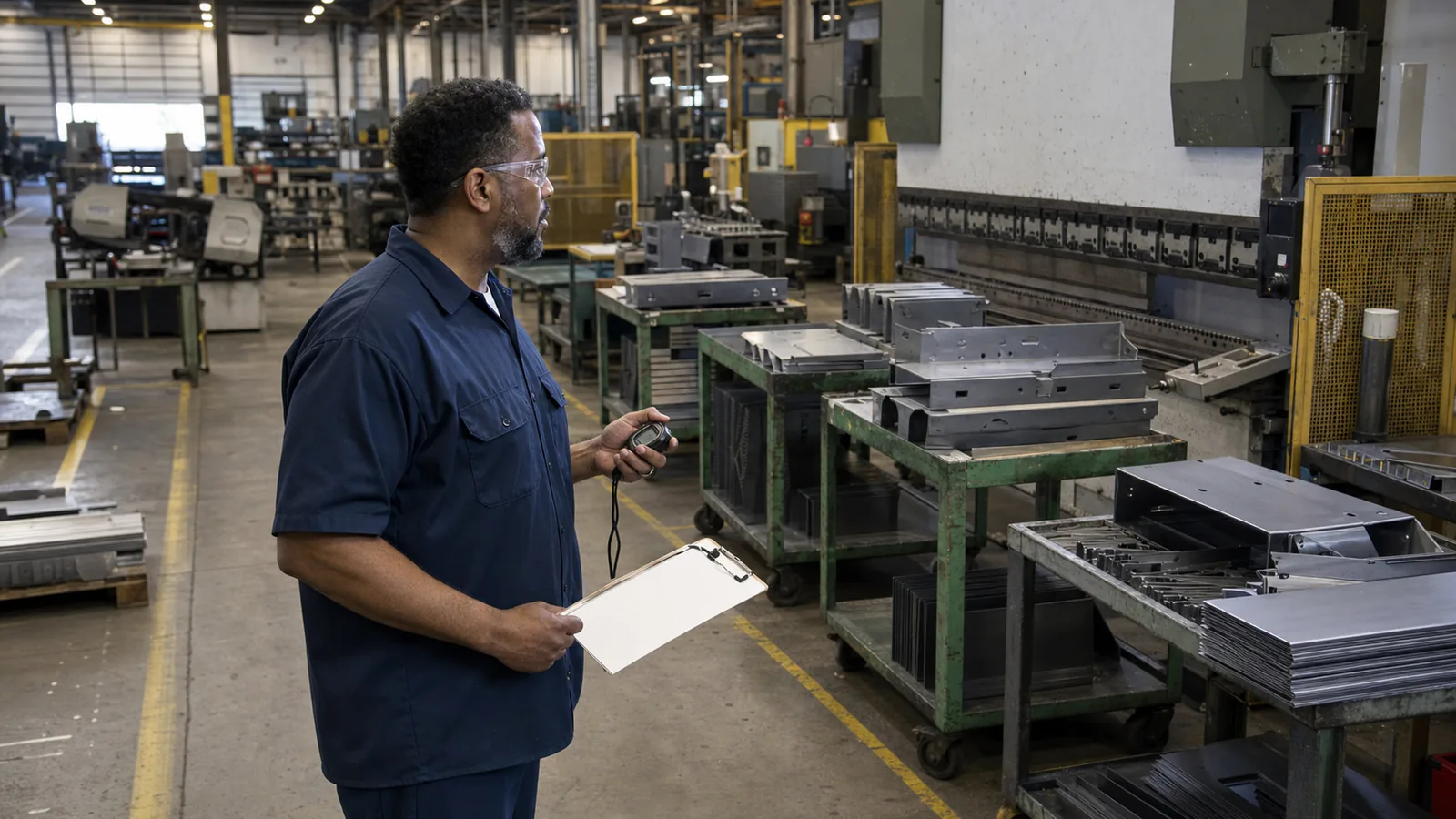
Find fabrication bottlenecks by tracking queues, setup, cycle time, uptime, rework and material flow before investing in additional machinery.
When work piles up in front of a machine, the answer appears obvious: buy a faster machine.
Sometimes that is exactly the right decision. Sometimes the machine is waiting on material, tooling, a program, inspection or an operator. Adding capacity to the wrong step can move the pile without improving shipments.
Before you request another equipment quote, spend a week finding the true constraint.
What a bottleneck looks like
A bottleneck is the step that limits the output of the system for the current mix and demand. It may move when the product mix, staffing or schedule changes.
Common signs include:
- A persistent queue before one operation
- Downstream employees waiting for parts
- Overtime concentrated in one department
- Expedites that repeatedly need the same process
- Long lead time despite short run time
- Outsourcing used to relieve one operation
- Work released faster than it can be completed
A busy machine is not automatically the bottleneck. A machine can look fully occupied while spending much of the day in setup, waiting or rework.
Draw the actual flow
Choose one representative product family and follow it from released material to shipment.
Write every step:
- Material retrieval
- Cutting
- Deburring or preparation
- Punching or drilling
- Forming
- Welding or assembly
- Finishing
- Inspection
- Packing
Include movement, waiting and outside processing. The official routing may say a part spends ten minutes in cutting and fifteen minutes in forming. The actual calendar may show two days waiting between them.
NIST’s manufacturing guidance describes layout, routing, inventory, batch sizes, cycle times, maintenance, reliability and labor assignment as variables that can be analyzed when identifying constraints and improving throughput.
Collect one week of simple data
You do not need a new software platform to begin. Use a board, spreadsheet or paper form.
For each operation, record:
- Jobs waiting at start of shift
- Setup minutes
- Run minutes
- Parts completed
- Downtime minutes and reason
- Scrap or rework
- Operator waiting time and reason
- Jobs waiting at end of shift
Separate setup from run time. Separate machine failure from material shortage. If every delay is entered as “downtime,” the data cannot guide a decision.
Measure flow, not only machine speed
Useful questions include:
- How long does one good part take?
- How long does a batch occupy the station?
- How much time passes from arrival to completion?
- How often does the job return for correction?
- How much work waits before and after the station?
- What percentage of available time produces acceptable parts?
A station with a slow cycle can still support the system if demand is low. A fast station with long changeovers can constrain a high-mix shop.
Look for six common causes
1. Insufficient equipment capacity
The machine may simply be unable to complete the required volume in available hours. Verify with observed cycle, setup, uptime and demand—not theoretical speed.
2. Setup and changeover
Tool searches, manual measurements, program creation and first-piece approval can consume more time than production. Standard tooling locations, prepared programs, setup sheets and quick-change features may release capacity.
3. Material handling
The machine may wait for a forklift, crane, bundle, cart or second person. A roller table or better staging can sometimes improve output more quickly than a new machine.
4. Quality and rework
Parts that circle back consume capacity twice. Track the cause: material variation, worn tooling, unclear drawings, setup, inspection or machine condition.
5. Maintenance and reliability
Repeated short stops can be easy to accept and expensive in total. Record failure modes and response time. Preventive maintenance, spares or service support may be the first investment.
6. Scheduling and batch policy
Large batches reduce the number of setups but can create excess work-in-process and starve other jobs. Small batches improve flow but may expose slow changeovers. Test the policy against the product mix.
Ask whether the constraint is the machine or the process around it
Observe one complete job at the suspected constraint.
Create two columns:
| Machine working | Machine available but not producing |
|---|---|
| Cutting, bending, punching or forming | Waiting for material |
| Productive automatic cycle | Waiting for drawing or program |
| Approved setup activity | Waiting for tooling |
| Planned inspection within the cycle | Waiting for inspection |
| Moving or stacking parts | |
| Clearing preventable jams |
This is not an argument against buying equipment. It is a way to specify the right equipment. If manual gauging dominates the lost time, a better positioning system may matter more than additional tonnage. If loading dominates, automation or material support may be central. If the machine itself runs continuously and the queue keeps growing, additional capacity becomes a stronger case.
Test low-cost changes first
Before approving capital, try controlled changes such as:
- Stage material and tooling before the shift.
- Create standard setup sheets.
- Separate internal setup from tasks that can occur while the machine runs.
- Move frequently used tools closer.
- Establish clear first-piece approval.
- Repair recurring minor failures.
- Adjust batch size for one product family.
- Add a temporary support table or cart.
- Cross-train an operator where appropriate.
Use a plan-do-check-act approach: define the change, run it, measure the result and keep it only if the data improves.
Know when another machine is justified
A capital project becomes more credible when:
- The constraint is stable across the expected product mix.
- Existing equipment runs near its practical available capacity.
- Setup, material and quality losses have been addressed or included in the specification.
- Demand is supported by orders or a reasonable forecast.
- The next process can absorb the added output.
- Labor, tooling, utilities and space are available.
- The expected financial benefit survives a conservative scenario.
NIST notes that simulation can help manufacturers test layout, scheduling, product-mix and capacity changes before implementing them. A small shop may use a simple spreadsheet model; a complex line may justify formal simulation.
Turn bottleneck data into an equipment specification
If equipment is the answer, bring the evidence to the buying conversation.
For example:
- Current setup: 42 minutes; target: under 15
- Current output: 85 good parts per shift; required: 130
- Current rework: primarily length variation
- Material: specified grades and size range
- Operator time: 35 percent manual measuring and positioning
- Constraint: loading long material with no support
That information changes the discussion from “We need a faster saw” to “We need a cutting system that reduces setup, controls length and supports this material range at the required output.”
Frequently asked questions
Is the machine with the largest queue always the bottleneck?
It is a strong clue, not proof. Release policy, batch size, rework and scheduling can create a queue that does not represent the true system constraint.
How long should we collect data?
Start with one representative week. Extend the review when demand or product mix varies significantly.
What if the bottleneck moves every day?
High-mix operations can have a shifting constraint. Group products into families and evaluate the mix, shared resources and scheduling rules.
Can automation solve a bottleneck?
It can when handling, positioning or unattended cycle time limits the process. It can also automate waste. Define the constraint and expected result first.
Bring GT Machinery Solutions the constraint, not only a category name
Tell us what is waiting, what the current process produces and where the time goes. We can help you translate the operational problem into equipment requirements worth comparing.
CTA: Discuss Your Production Constraint
Related reading
- How to Choose Industrial Metalworking Machinery
- The True Cost of Industrial Machinery
- Industrial Machine Installation Checklist
- Contact Us
Sources
Important: Verify capacities, guarding, installation requirements and safe operating procedures with the machine manufacturer, current manuals and qualified personnel before purchase or use.