
Blog
How to Choose an Ironworker Machine for Your Fabrication Shop

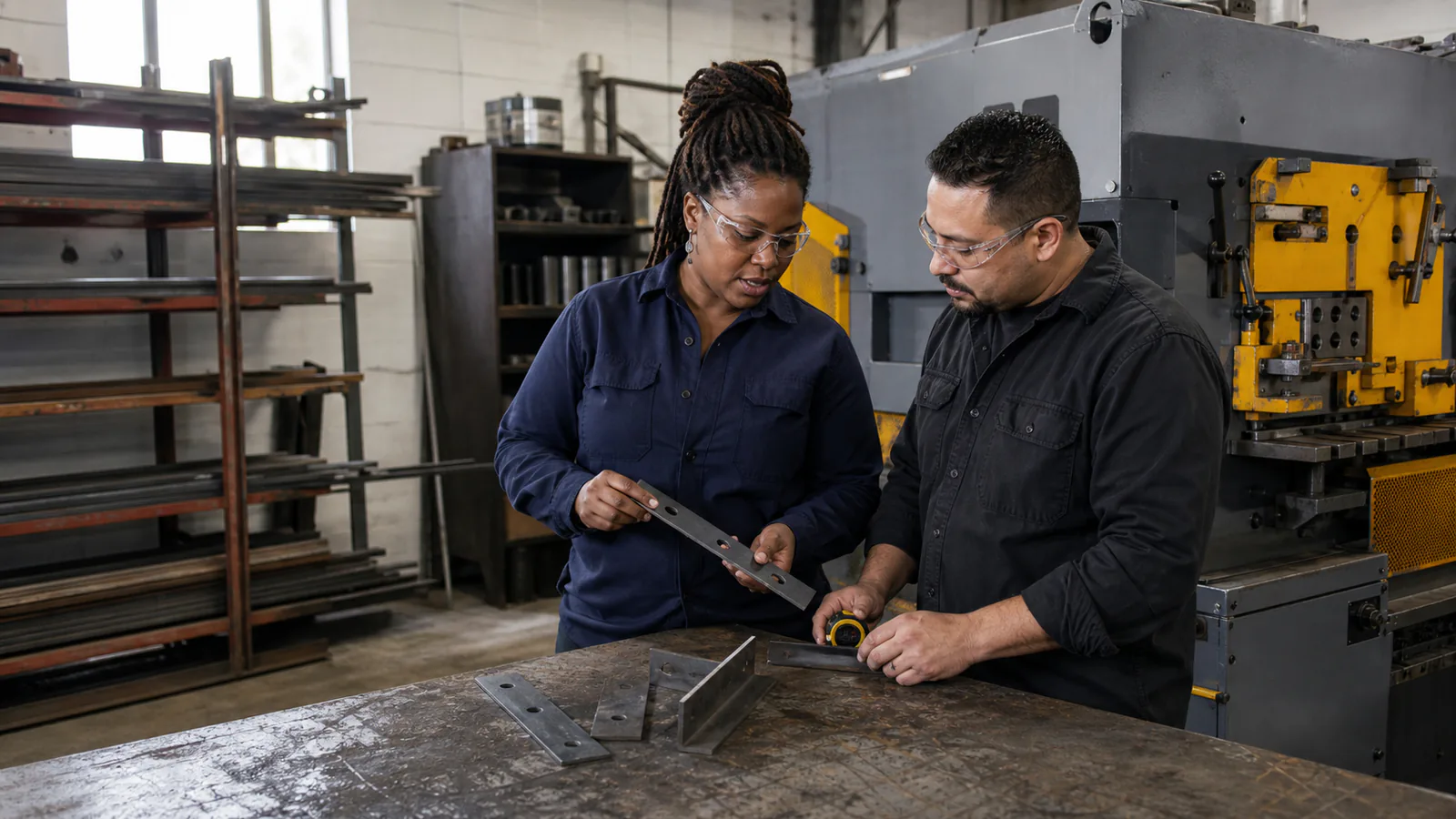
Choose an ironworker by punching requirements, shear capacity, stations, attachments, operator flow, safety, support and total installed cost.
An ironworker earns floor space by doing several jobs in one compact system. Punching, flat-bar shearing, angle shearing, notching and optional forming can all live on the same machine.
That versatility is valuable, but it creates a buying trap: comparing ironworkers only by tonnage.
Tonnage matters, especially at the punch station. It does not tell you whether the material fits the throat, whether the shear handles your angle size, whether two operators can work without waiting or whether the tooling you need is available.
Choose the machine station by station.
Begin with a one-week operation log
Before looking at models, record every operation that you would reasonably send to an ironworker for one normal week.
For each job, capture:
- Material type
- Shape: plate, flat bar, angle, round, square or channel
- Thickness and dimensions
- Hole shape and size
- Distance from the edge to the hole center
- Required cut or notch
- Quantity
- Current setup and cycle time
- Secondary cleanup
The log reveals which station will carry the workload. A shop that punches hundreds of repeated holes needs a different configuration from a maintenance shop that alternates constantly among shearing, notching and bending.
Size the punch station correctly
Ironworkers are commonly described by punch tonnage, but required punching force depends on the job.
Important variables include:
- Punch perimeter
- Material thickness
- Material shear strength
- Punch and die condition
- Required clearance
A one-inch round hole and a one-inch square hole do not have the same perimeter. Increasing thickness or material strength increases the required force. Non-round punches and large openings must be reviewed carefully.
Scotchman’s ironworker selection guidance recommends evaluating the actual material and application instead of treating tonnage as a stand-alone number. Have the manufacturer or supplier verify the most demanding hole using current tooling and capacity data.
Also check throat depth. The machine may have adequate force but still be unable to place the hole far enough from the material edge.
Review every shear station against real stock
Do not accept “includes angle shear” as a complete answer.
Confirm capacities for:
- Maximum flat-bar width and thickness
- Angle leg dimensions and thickness
- Round-bar diameter
- Square-bar dimensions
- Channel or other structural shapes, if supported
Ask how the material is supported and gauged. A capacity rating tells you whether the cut is permitted; it does not tell you how quickly an operator can repeat it to length.
Backgauges, stops, support tables and measuring systems can turn a versatile machine into a repeatable production station. Without them, the operator may spend more time measuring and handling than cutting.
Decide between single- and dual-operator flow
On some ironworkers, only one station can cycle at a time. Dual-operator designs may allow two people to work at separate stations, depending on the machine.
Do not assume that two available workstations mean simultaneous production. Ask the manufacturer to describe the control logic and demonstrate the intended workflow.
A single-operator machine may be entirely appropriate when:
- Work is intermittent.
- One person controls the entire job.
- Floor space and investment are priorities.
- Station conflicts are rare.
A dual-operator arrangement may create value when:
- Punching and shearing run at the same time.
- Queues regularly form at the machine.
- Separate operators already handle the processes.
- The additional output has measurable demand.
Choose attachments from the job list
Ironworkers can accept a wide range of optional tooling. Common examples include bending attachments, pipe notchers, channel shears, special punches and dies, and custom work supports.
An attachment is useful only if it improves a recurring operation. For each option, ask:
- Which current job will use it?
- How often?
- What setup is required?
- Does it reduce capacity or working space?
- Where will it be stored?
- Can replacement tooling be obtained later?
Budget the complete starting tooling package. A machine delivered without the punches, dies, stops or supports needed for the first jobs is not production-ready.
Look beyond motor horsepower
Horsepower alone does not define ironworker performance. The hydraulic system, frame, beam, pins, controls, stroke adjustment and machine geometry work together to produce and manage force.
Evaluate:
- Rated tonnage at the relevant station
- Working pressure and hydraulic design
- Frame and beam construction
- Stroke control and adjustment
- Duty expectations
- Cycle rate under actual work
- Oil capacity and maintenance access
Listen during a demonstration, but do not diagnose machine quality from sound alone. Request technical explanations and documentation.
Put safety into the specification
Punches, shears and notchers create point-of-operation hazards. Review guards, hold-downs, stripper arrangements, emergency stops, foot controls, control visibility and the way material is placed and removed.
OSHA’s general machine-guarding guidance specifically identifies shears and power presses among equipment that may require point-of-operation guarding. Safeguards must work with the actual tooling and material—not only the machine in its standard display configuration.
Employers must also develop appropriate training and energy-control procedures. Ironworkers store hydraulic and mechanical energy that must be considered during setup, clearing and maintenance.
Never select or modify guarding solely from a blog article. Use the current manual, applicable standards and qualified safety personnel.
Evaluate support for a long-life machine
An ironworker is usually a long-term purchase. Support should be evaluated on that timeline.
Ask:
- Is the current manual available?
- How are parts identified and ordered?
- Are standard punches and dies readily available?
- Can custom tooling be reviewed?
- Who provides technical support?
- What commissioning is included?
- What does the written warranty cover?
- Are electrical and hydraulic diagrams supplied?
Scotchman’s published guidance emphasizes long-term tooling, replacement parts and manufacturer support as selection factors. The exact supplier may change, but the principle is sound: a durable frame is only part of machine availability.
Include material handling in the layout
Ironworkers are compact, but the stock may be long and heavy.
Plan clear infeed and outfeed space for angle, flat bar and other structural material. Include racks, roller supports, stops, scrap containers and safe pedestrian routes. Check whether operators can see the work and controls without standing in the path of long stock.
Confirm machine weight, anchoring, electrical supply and service clearance before delivery.
Ironworker selection checklist
- Most demanding punch verified
- Required throat depth confirmed
- Flat-bar shear capacity confirmed
- Angle shear capacity confirmed
- Round and square capacity confirmed
- Notcher size confirmed
- Single- or dual-operator workflow selected
- Initial punches, dies and attachments priced
- Gauging and material supports included
- Guarding reviewed for intended tooling
- Voltage and phase confirmed
- Delivery, anchoring and training planned
- Manuals, parts and technical support confirmed
Frequently asked questions
Is a higher-tonnage ironworker always better?
No. Higher tonnage is valuable only when the application requires it. Station capacities, throat depth, tooling, workflow, footprint and cost must also fit.
Can an ironworker replace a press brake?
An ironworker bending attachment can handle suitable operations, but it does not automatically replace a dedicated press brake. Compare bend length, tooling, control, repeatability and production needs.
Can two operators use an ironworker at the same time?
Only on machines designed and controlled for that workflow. Confirm the specific model’s operating logic and safety requirements.
How do I calculate punch tonnage?
Force depends on punch perimeter, material thickness and shear strength, along with tooling factors. Have the proposed job verified using current manufacturer data.
Send the work, not just the desired tonnage
Give GT Machinery Solutions your material list, hole sizes, structural shapes, quantities and required stations. We will help you turn that work into a comparison checklist.
CTA: Discuss Your Ironworker Requirements
Related reading
- How to Choose Industrial Metalworking Machinery
- The True Cost of Industrial Machinery
- Industrial Machine Installation Checklist
- Contact Us
Sources
Important: Verify capacities, guarding, installation requirements and safe operating procedures with the machine manufacturer, current manuals and qualified personnel before purchase or use.